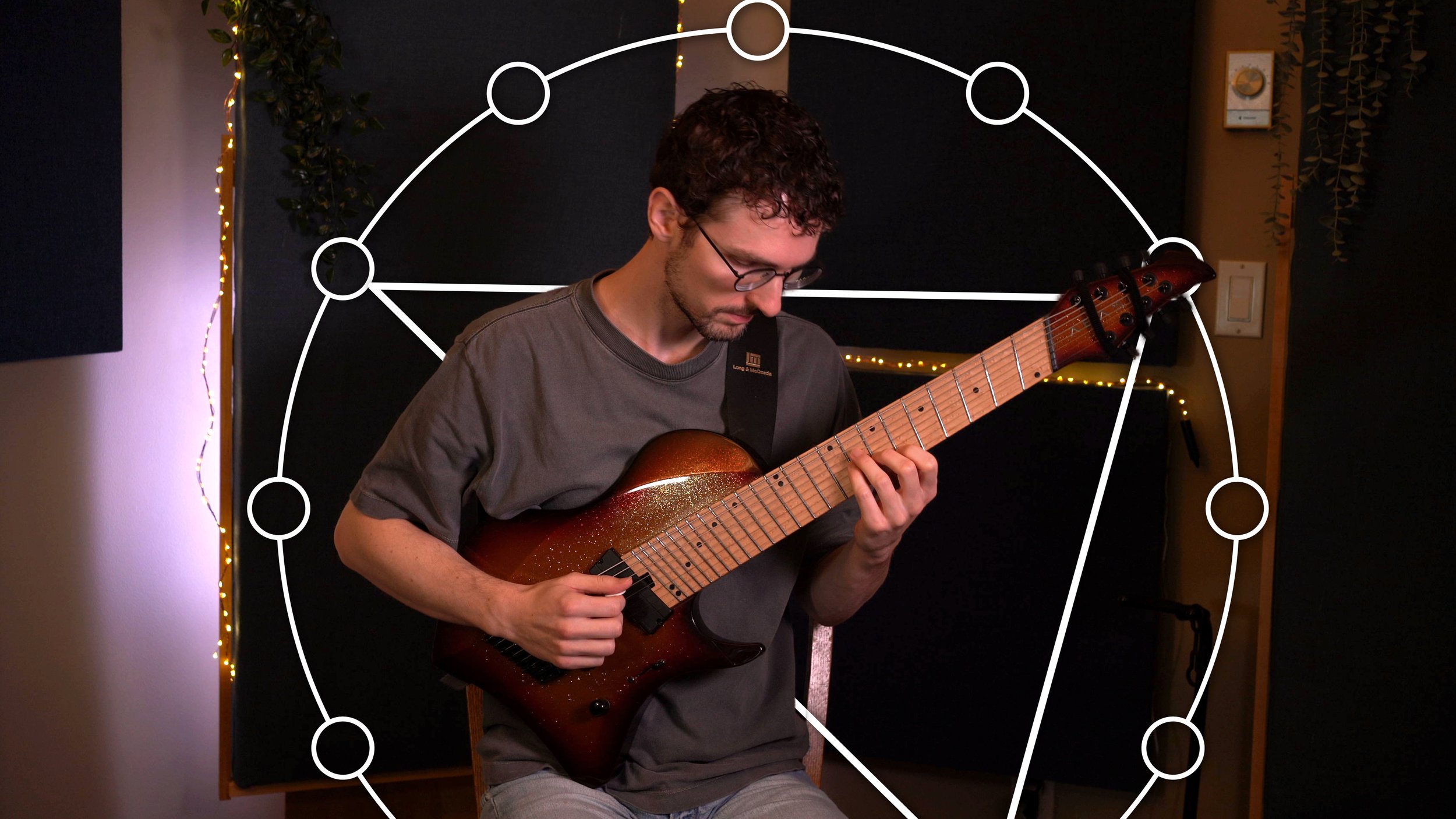
Sweeping Triads: Foundations for Mastering the 8-String Guitar
Improve your fretboard navigation while learning how to shred. Crafted for the 8-String Guitar.
-
Introduction
-
Chapter 1
-
Chapter 1 - Introduction & Overview
What to expect in Chapter 1.
-
The Major Triad: Core 3-String Shapes
Learn the core 3-string major triad shapes across the entire 8-string neck.
-
The Minor Triad: Core 3-String Shapes
Learn the core 3-string minor triad shapes all across the neck.
-
Triad Theory Fundamentals
Let’s take a brief finger break to make sure our triad theory is where it needs to be.
-
The Diminished Triad: Core 3-String Shapes
Learn the core 3-string diminished triad shapes all across the neck.
-
The Augmented Triad: Core 3-String Shapes
Learn the core 3-string augmented triad shapes all across the neck.
-
Guitar Pro: Best Practices for the Best Practice
Guitar Pro files are given out like candy these days, but they can turn practice mindless. Learn how to best use them here so you don’t become reliant on them.
-
The Suspended Triad: Core 3-String Shapes
Learn the core 3-string suspended triad shapes all across the neck.
-
What to Practice Next
Before moving on to Chapter 2, let’s examine some ways to advance your practice for those who want to truly internalize this material.
-
-
Chapter 2
-
Chapter 2 - Introduction & Overview
What to expect in Chapter 2.
-
Chaining Practice and the 4-String Major Triad
Moving onto the 4-string shapes in this chapter along with some concepts to deepen your practice, beginning with Chaining.
-
Burst Chaining and the 4-String Minor Triad
Learn another chaining method, known as “burst chaining” while learning the 4-string minor shapes.
-
Strings {2-8} and the 4-String Diminished Triad
Time to address the other string sets with our 4-string shapes, while learning the 4-string diminished shapes.
-
Circle of 5ths and the 4-String Augmented Triad
I hope you practiced keeping track of the inversions during your 3-string augmented triads because you’re going to need it with these 4-string exercises.
-
Legato Integration and the 4-String Suspended Triad
We’ve been doing a lot of picking up until now - essential to developing a clean sweeping technique - but let’s take a look at adding some legato techniques too. Get ready to stretch your fingers too as we loot at the 4-string suspended shapes.
-
Sweeping Technique from the Perspective of Movement
Now that we have some practice hours under our belts, let’s get into the details of the sweeping technique.
-
Suspended Triad Deep Dive: Superimpositions
The suspended triad doesn’t highlight functional harmony when used as its own standalone sound, so let’s examine some ways we can use it with functional harmony. All the ways.
-
Prepping for Chapter 3: What to work on
Before moving on to Chapter 3, let’s see what is worth revisiting before moving on.
-
-
Chapter 3
-
Chapter 3 - Introduction & Overview
What to expect in Chapter 3.
-
5-String Sweeps through the Major Scale
Our final chapter brings us toward full 8-string sweeps. To get there though, we have to first move through our 5-string shapes. At the same time, we will be putting our triads through diatonic scales, beginning with major.
-
6-String Sweeps through Harmonic Minor
Continuing on to the 6-string triad shapes and the diatonic chords in harmonic minor.
-
Theory - Diatonic Triads in Major, Harmonic Minor, and Melodic Minor
Let’s take a finger break to go through what triads are found in the three core scales we are looking at in this course: Major, Harmonic Minor, and Melodic Minor.
-
7-String Sweeps through Melodic Minor
7-string sweeps start to feel a little bit unwieldy. But with some clever hand movement, we can get these smooth like the rest.
-
8-String Sweeps and Non-Linear Triad Shapes
You’ve made it to the summit. Let’s get into the full 8-string triad sweep plus a powerful way to go beyond them and start using the strengths of the guitar to your benefit.
-
Wrapping Up: Structuring Where to go Next
A recap of what we have done up until now, in a practical and usable way.
-
Where do we go from here?
Now that we’re done, what’s next? (After you take a break, of course).
-
What You Will Learn
This course’s foundational goal is to help 8-string guitarists learn and understand their fretboard. It is common to find guitarists who feel lost while playing, not knowing what they are doing. And with two extra strings, the problem has only worsened. Rather than learning each note individually, we need to build mental structures that reveal the patterns of the instrument, while also being musically useful.
Fretboard Navigation
And what are those structures? Triads. The harmonic foundation for nearly all of western music. These “shapes” are key to building a robust understanding of the fretboard while also being practically useful, no matter what genre of music you play.
Triads
Triads can be expressed any number or ways but sweep picking was chosen very intentionally.
Sweep picking focuses our attention onto the vertical movement across strings. Compared to horizontal movement (up and down the neck), vertical moves can be faster and more fluid. They also allow us to visualize larger groupings of notes on the neck. Along with static movement, vertical movement is also the most common, so is worth working on a considerable amount.
Sweep Picking
FAQ
-
This course is best suit intermediate players who have some familiarity with theory concepts like intervals, scales, and chord types, but who haven’t meaningfully put them into practice. However, there is something to be gained for beginner players who are starting out with their triads all the way to advanced players looking for new practice concepts.
-
The course is split up into 3 chapters with around 5 lessons in each (plus theory and technique videos).
My suggested pacing is to complete 1 of these lessons per week to give yourself enough time to practice between lessons. This will result in about 3 months in total (or 1 semester).
Some may choose to advance more quickly or slowly though depending on their ability level and understanding.
-
Absolutely. Metal music is filled with triads and sweep picking. And having a better understanding of these topics means that you will be able to more quickly learn songs or write ideas out because you will be able to chunk the information faster.
-
This is not a course that promises immediate results or effortless improvements. And besides some tempo increases, the progress is not easily measurable. What we are focused on doing is building a foundation for true understanding of the guitar, and with true learning, progress is not linear.
-
Most of the exercise materials (75% to be precise) will be playable on 6-strings. And the core concepts still apply. The only adjustment you’ll need to make is leaving out any sections of exercises that use the 7th or 8th strings.
Chapter 3 also includes dedicated lessons for 7 and 8-string sweeps that will not be translatable.
What’s Included
6+ Hours of Video Content
Lesson videos include real-time play-throughs of the materials that you can practice along with, plus theory and technique videos to support the materials along the way.
Guitar Pro Files
Each play-through lesson comes with the GP file for you to download and use in your own practice sessions. We also go over best practices to get the most out of these files.
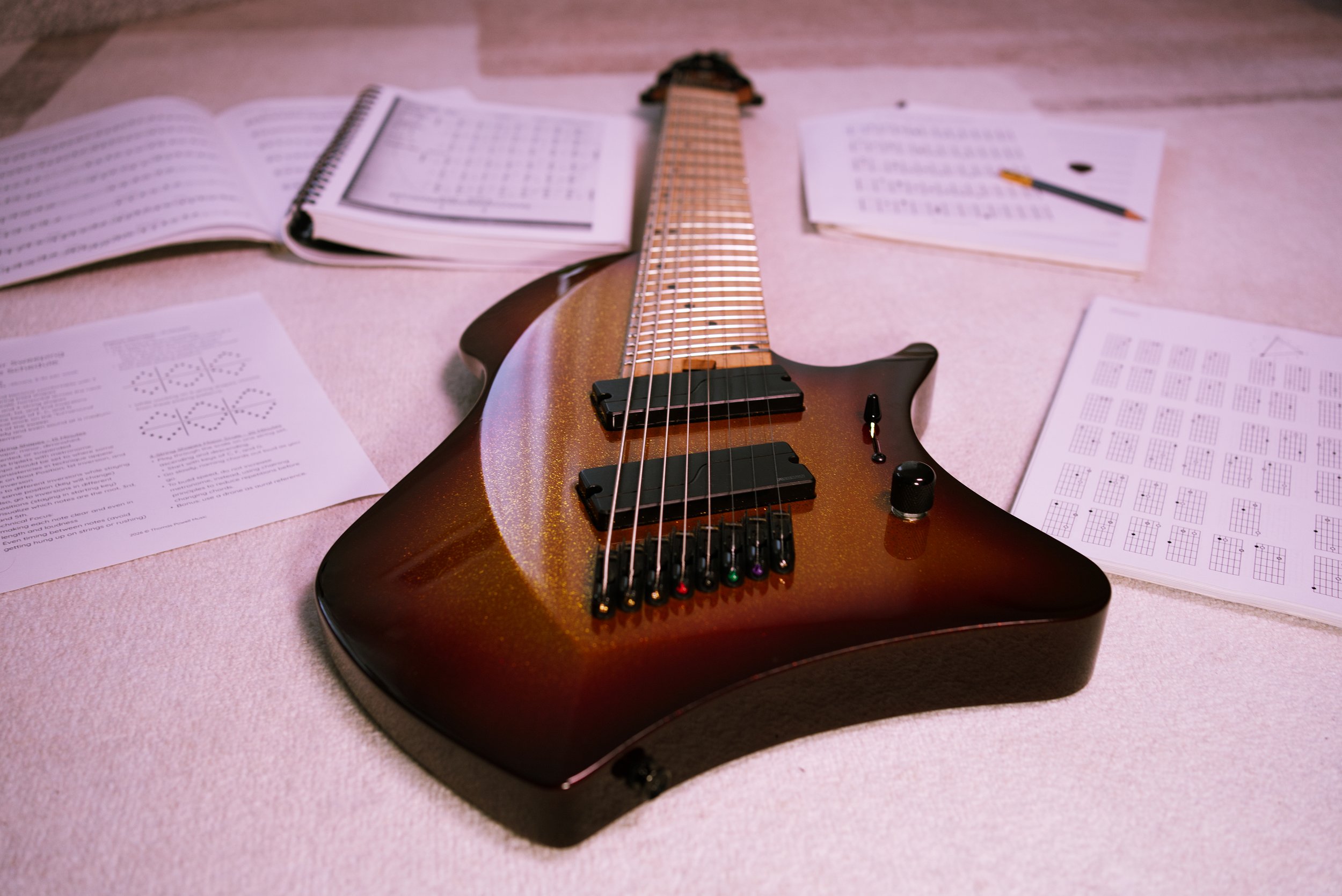
Custom PDFs
Including theory summaries, practice plans, and diagrams to help support your learning and understanding of the lesson materials.